SEO Blogs
    On our SEO blog, find articles and resources on how to optimize your website to improve search engine rankings including Local SEO, Technical SEO and more.
    • Latest SEO News, Insights & Updates
    Added on 20 August

    For over two decades, the relationship between search engine and content creator was governed by a simple, unspoken contract: you write high-quality content that answers users' questions, Google ranks your page, and Google sends you a visitor.


    That contract has been unilaterally cancelled.


    With the rapid introduction of Generative AI and AI Overviews, Google has shifted from being the road to your website to becoming the destination itself. By scraping publisher content, synthesizing it, and presenting the final answer directly on the search engine results page (SERP), Google now intercepts the very traffic it used to send.


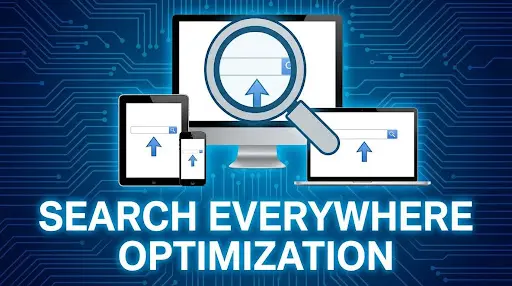
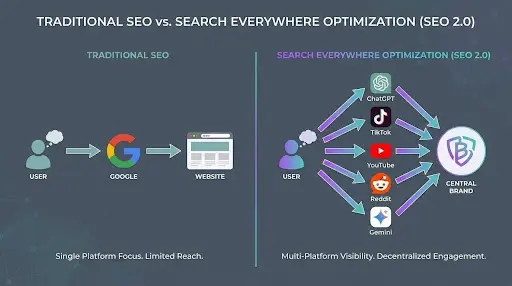
    This is not a temporary algorithmic fluctuation; it is a fundamental shift in how the internet operates. For digital publishers, e-commerce brands, and B2B marketers, survival requires a complete evolution of strategy. We must transition from Search Engine Optimization (SEO) to Search Everywhere Optimization (SEO 2.0) - shifting our focus from "renting" traffic from Google to "owning" brand demand across the entire digital ecosystem.

    The Shift to Search Everywhere Optimization


    1. The Hard Numbers: Inside the Google Traffic Collapse


    The decline in organic search click-through rates (CTR) is backed by industry-wide tracking data and internal agency audits:


    • The Impact of AI Overviews: AI Overviews now appear on close to half of all Google searches. When an AI Overview is present, click-through rates to organic websites drop by approximately 60%. The searcher reads the generated answer, obtains the information they need, and stays on Google.


    • The Transition to AI-Only Search: Google’s "AI-only mode"—which completely removes traditional blue links—is still relatively small but is currently doubling in volume every quarter.


    • The Traffic Decline Timeline: Internal client audits conducted by global digital marketing agency NP Digital show a clear pattern of traffic decay:


    • 2023 (Pre-AI Overview expansion): Global organic traffic was still growing, averaging +6% year-over-year.


    • Launch Year of AI Overviews: Organic search traffic dropped to -7%.


    • The Following Year: Organic traffic declined further, averaging -13% year-over-year.


    2. Rented Traffic vs. Owned Brand Demand: The HubSpot Case Study


    The biggest losers in this transition are not those who ignored search engine optimization, but rather the publishers, blogs, and directories who mastered traditional SEO. For years, these businesses built skyscrapers on leased land, relying on a landlord (Google) who has now changed the rules and locked the doors.


    A perfect illustration of this paradigm shift is HubSpot, a company renowned for having one of the most sophisticated inbound marketing and SEO teams on Earth.
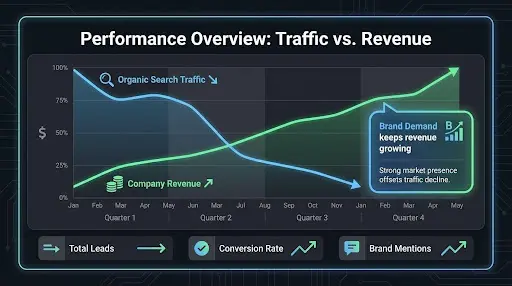

    • The Clicks Left: As AI Overviews began answering CRM, marketing, and sales queries directly on the SERP, HubSpot’s organic search traffic plummeted by approximately 80% in a single year (according to industry estimates from Ahrefs and SEMrush). During an earnings call, HubSpot’s executive leadership confirmed that AI Overviews were directly answering user queries, resulting in far fewer clicks through to their blog.


    • The Demand Stayed: Under traditional metrics, an 80% drop in organic search traffic would spell financial ruin. Yet, over that exact same stretch, HubSpot’s revenue grew by more than 20%.


    HubSpot: Organic Clicks vs Company Revenue


    The Clicks vs. Demand Equation


    HubSpot survived—and thrived—because they understood that clicks and brand demand are not the same thing. While generic search clicks disappeared, customers did not stop searching for HubSpot. Instead of searching for generic terms like "best CRM software," users searched directly for the brand name "HubSpot".


    Currently, the average website receives just 2.4% of its organic search traffic from branded queries. However, top-performing brands receive nearly 10% (almost four times the average). When users search for your brand name directly, Google cannot easily intercept the click with an AI summary, making branded search traffic highly resilient to the zero-click collapse.


    3. The "Danger Zone" of Content Sameness


    If your website's content reads like a commodity, it is highly vulnerable to AI displacement.


    The primary test of whether your content will survive is simple: If a hundred other websites already answer a query the same way you do, AI can and will replace all of you with a single, summarized paragraph.


    AI models excel at absorbing generic "how-to" guides, basic definitions, and superficial reviews, and serving them back to the user without sending a single visitor your way. Several major publishers are already feeling the weight of this content commoditization:


    • CNN: The legacy news publisher has seen its organic search traffic decline by approximately one-third (33%) year-over-year as search engines increasingly summarize news and general information directly.


    • Forbes Advisor: Built as a highly lucrative affiliate arm on top of Forbes’ main domain reputation, Forbes Advisor was heavily penalized by Google for "site reputation abuse," resulting in a massive, sudden loss of search visibility.


    • The Sameness Penalty: Content that lacks a distinct human "fingerprint"- such as a product review written by someone who never actually tested the product, or a definition page that offers no unique industry insight—is easily absorbed by AI models. Because the AI has thousands of identical sources, it has no structural need to link to or credit your specific site.


    4. The Barbell Theory of Content Survival


    To explain how digital media will survive this transition, Condé Nast CEO Roger Lynch (who oversees elite brands like Vogue, GQ, and The New Yorker) proposed the Barbell Theory of Content Survival.


    Lynch argues that the digital publishing and content landscape is splitting into two distinct, winning poles, leaving the middle tier in a structural crisis:
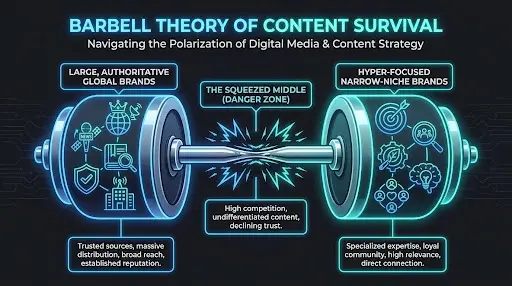

    The Barbell Theory of Content Survival


    • The Left Bell (Massive Authority): At one end are massive, trusted, and highly authoritative legacy brands. These are the names people trust implicitly. For example, The New Yorker recently recorded its best business year ever, proving that premium, high-trust editorial content remains highly insulated.


    • The Right Bell (Hyper-Focused Niches): At the other end are small, hyper-focused brands that completely own a narrow niche. These brands possess highly dedicated, passionate audiences who are often willing to pay directly for their expertise.


    • The Squeezed Middle (The Danger Zone): The middle of the barbell is occupied by mid-sized websites that are not authoritative enough to be the primary name people trust, yet are not focused enough to completely own a specific niche. These generalist, mid-tier sites are being squeezed out completely.


    Lynch has instructed his editorial and business teams to plan as if organic search traffic from Google is going to zero. Content creators must ask themselves: Which end of the barbell do we occupy, and who would honestly miss our brand if it disappeared from the internet tomorrow?


    5. The "Search Everywhere" Playbook: Case Studies in SEO 2.0


    Search Everywhere Optimization (SEO 2.0) recognizes that user search behavior has decentralized. Consumers no longer rely on a single search box on Google; they search across an array of platforms depending on their immediate intent.


    The Decentralized Search Landscape


    AI Search Engines: OpenAI’s ChatGPT alone now handles over 1 billion searches per day. Platforms like Gemini and Perplexity are rapidly capturing informational search share.


    Social & Visual Search: Approximately 1 in 5 people (20%) now start their search journey inside a social media app (such as TikTok, YouTube, Instagram, or Reddit), up from a negligible 1% in 2021. Users ask Reddit for unfiltered human opinions, watch TikTok for visual reviews, and use YouTube for in-depth tutorials.


    Case Study: Dotdash Meredith ("People Inc.")


    Dotdash Meredith (the digital publishing giant behind brands like People, Better Homes & Gardens, and Investopedia) provides the ultimate blueprint for thriving in the SEO 2.0 era:


    • The Challenge: Over a two-year period, Google's share of Dotdash Meredith's total incoming traffic plummeted from 55% down to just 25%. This was heavily driven by AI Overviews, which began showing up on nearly 70% of their top 10,000 traffic-generating keywords.


    • The Pivot: Rather than attempting to fight the search engine, the company aggressively diversified:


    • They expanded their off-platform presence on Instagram, TikTok, YouTube, and Apple News, growing their off-platform audience by over 60%.


    • They signed lucrative direct licensing agreements with major AI labs, including OpenAI and Meta, to ensure they are paid directly for their content being used to train and feed LLMs.


    • They developed proprietary, direct-to-consumer apps to bypass third-party search distribution entirely.


    • The Result: Despite losing over half of their Google search traffic, Dotdash Meredith’s digital revenue grew by 8% in a single quarter, reaching $253 million.


    Case Study: High Level


    The business software company High Level successfully drove a surge in direct brand demand by building an exceptional product that integrates AI automation (such as calling leads automatically for clients). The sheer utility of their product created organic word-of-mouth, causing their brand-name searches to skyrocket, bypassing traditional generic keyword competition entirely.


    6. Actionable Tactics: How to Audit & Build Your Brand Everywhere


    Transitioning to SEO 2.0 requires active diagnostic tracking and multi-channel asset creation.


    Step 1: Conduct an AI Search Visibility Audit


    You can no longer rely solely on Google Search Console to understand your visibility. Marketers must actively monitor how AI models talk about their brand behind the scenes and implement strategies to improve visibility in AI and voice search.


    • Track LLM Mentions: Utilize specialized tools, such as the AI Search Visibility tool within


    • Ubersuggest, to measure how often your brand is mentioned by ChatGPT, Gemini, and Claude.


    • Analyze Brand Sentiment: Audit whether the references to your brand in AI outputs are positive, neutral, or negative.


    • Benchmarking: Track your AI visibility and sentiment shares directly against your primary competitors to see who the LLMs recommend most.


    Step 2: Inject a Unique "Fingerprint" Into Your Content


    To prevent your content from being absorbed and dismissed by AI, every page you publish must feature elements that cannot be replicated by a machine:


    First-Party Data & Proprietary Testing: Include original charts, data points, and experimental results.


    Strong Editorial Voice: Write with clear, authoritative opinions, distinct formatting, and subjective, real-world case studies.


    Expert Authorship: Highlight real, credentialed human experts who have genuinely utilized or tested the subject matter.


    7. Strategic Extensions: Advanced SEO 2.0 Tactics (Beyond the Video)


    The following strategies represent advanced industry practices compiled to extend the core principles of Search Everywhere Optimization into technical and business execution.


    A. Technical Optimization for LLM and RAG Ingestion


    To ensure your brand is cited and recommended inside conversational AI models (like ChatGPT and Gemini), your site must be optimized for Retrieval-Augmented Generation (RAG) pipelines and follow a multi-layered framework for GEO, AEO, and LLMO:


    • Entity-First Schema Markup: Implement advanced JSON-LD schema (specifically utilizing SameAs, Organization, Person, and Product properties) to help LLM crawlers construct clean knowledge graphs linking your brand to specific industries or keywords.


    • RAG-Friendly Content Architecture: Format key pages with clear, logical hierarchies. Use Markdown-like header structures (H2, H3), direct "Question-and-Answer" block formats, and bulleted summaries. This makes it highly efficient for LLM parsers to extract and cite your content.


    • Crawler Access Management: Monitor your log files for AI crawler bots (such as GPTBot, ClaudeBot, and Google-Extended). If your business model relies on licensing, ensure these bots are managed via your robots.txt to maintain leverage in commercial data negotiations.


    B. Platform-Specific Social Search Optimization (SSO)


    Because 20% of users search directly within social platforms, you must optimize your social assets with the same discipline once reserved for Google:


    • TikTok & YouTube Optimization: AI algorithms transcribe social video content in real-time. Verbally speak your target keywords within the first 15 seconds of your videos, place high-impact keywords in the video transcripts, write detailed keyword-optimized captions, and design text-rich thumbnails.


    • Reddit & Community Search: Google actively prioritizes forums in its search results. Establish a brand presence on Reddit by participating transparently in industry discussions, answering community queries without aggressive sales pitches, and earning organic upvotes to rank in both Reddit's native search and Google's "Discussions and Forums" search features.


    C. Direct Content Licensing Frameworks for Publishers


    For medium-to-large media brands, direct licensing represents the new organic traffic monetization model:

    • Valuation Metrics: Value your content library based on topical exclusivity, temporal relevance (historical archives vs. real-time news), and semantic formatting quality.


    • Hybrid Access Models: Structure licensing agreements that permit LLMs to scrape historical archives for training, while gating real-time, premium content behind paywalls or requiring direct, high-value API pricing for real-time citations.

    Frequently Asked Questions
    What is Search Everywhere Optimization (SEO)?
    Search Everywhere Optimization is a multi-platform search marketing strategy designed to ensure a brand is the trusted, consistent answer on every platform where a modern buyer searches—including traditional search engines (Google), social media (TikTok, YouTube, Reddit), and AI answer engines (ChatGPT, Claude)
    What is the benefit of the Google Search Console 'Platform Properties' feature?
    Platform Properties allows you to connect your social media profiles (TikTok, Instagram, X, YouTube) directly to your Google Search Console (Patel, 2026). This enables you to track which Google searches surface your social media posts, including the exact queries, impressions, and clicks
    Why does AI search traffic convert so much higher than traditional search traffic?
    According to NP Digital's research, visitors referred by AI convert at an 8x higher rate than traditional traffic (Patel, 2026). This occurs because the AI has already compared, vetted, and recommended your brand based on search criteria. By the time the user clicks through, they are pre-sold
    Are backlinks still important for AI search engine rankings?
    In NP Digital's analysis of 82 ChatGPT recommendation ranking factors, traditional backlinks scored only 1.9 out of 5, placing them near the bottom of the list. While backlinks still matter for traditional Google SEO, AI engines prioritize content relevancy and overall third-party brand mentions across the web
    How does inconsistent brand messaging affect AI recommendations?
    AI answer engines read your website, social media, press releases, and reviews as one single document to form an interpretation of your brand. If your messaging is contradictory across surfaces, the algorithm cannot form a clear conclusion, perceives your brand as a risk, and skips recommending you

    Other Listings

    Equipped With Latest Tools And Experienced
    New Cristal Academy | Best NEET and JEE Coaching Center
    skin care
    loader
    View More