


Every B2B sale starts with a conversation. Prospecting is the work of finding the right people to talk to in the right types of companies so you can have conversations that lead to sales (winning new business).
Whether you are a sales development rep (SDR), a sales professional with a similar job role, or a founder doing your own outbound, your pipeline is only as healthy as your prospecting.
This also applies to professionals in sectors like the law, where partners are responsible for generating their own prospecting pipeline.
In this guide, we cover what prospecting means, the main methods that work for B2B prospecting in 2026, and helpful tips to get better results.
Prospecting is always the first stage of the sales process. It means identifying people and companies who could plausibly buy from your business as a service provider, vendor, manufacturer, or professional services firm.
Every B2B business does prospecting. Whether you’re a tech giant like Salesforce or a Houston car accident lawyer, prospecting is an essential part of the sales process.
When prospecting, there are three phrases you need to be aware of. It’s the third and final one that you need to focus on, in a practical sense:
Now that you know your potential market (SOM), you’ve got to start reaching out to them to start conversations. Remember, sales is a numbers game, even for established law firms.
Not everyone will reply, so you may need to reach out to 5 to 10X as many people as you want to win as customers to start the conversations that lead to sales.
In B2B, that usually means finding key decision-makers, including CEOs, Directors, VPs, and C-level executives, at companies that match your Ideal Customer Profile (ICP), and engaging them until you have a pipeline of qualified opportunities.
Good prospecting comes down to three things:
Starting a conversation with someone who has not yet spoken to you (e.g., a decision-maker or budget-holder in a target company you want to win as a client).
Qualifying the prospect to decide whether they are a genuine fit or not (this is why having a qualifying process and ideal customer profile is so important).
Positioning your product as a solution to a problem they actually have (otherwise no one is going to become a customer).
During this process, prospecting also shows you what your market cares about, including its pain points, objections, and buying habits, and that feeds back into your messaging and even your product.
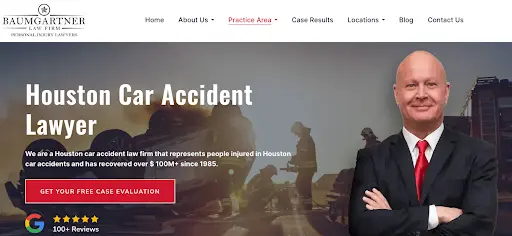
A firm like Baumgartner Law Firm uses its sales prospecting data to build its messaging, which helps it create content pages or landing pages.
The evidence that it is worth doing is strong.
Research from Rain Group suggests around seven in ten buyers want to hear from salespeople early in their buying process.
It also suggests that more than eight in ten accept meetings when a salesperson reaches out first. Reps who prospect consistently book far more meetings than those who neglect it.
In most SaaS and B2B teams, Sales Development Reps (SDRs) or Business Development Reps (BDRs) handle prospecting.
These are often the newest members of the team. They may contact hundreds of people a day, handle constant rejection, and qualify each conversation before passing good ones to Account Executives, who run demos and close deals. Marketing supports them by producing content that warms up prospects before the first touch.
Qualification usually follows a simple framework such as BANT:
Does the prospect have the Budget?
Is this person the Authority (a decision-maker or budget-holder)?
Is there a genuine Need?
Is the Timeline near enough to matter?
Two broad approaches exist, and strong sales teams use both.
Inbound prospecting attracts people who are already looking for a solution. It relies on content marketing, SEO, GEO, social media, and referrals. It’s less intrusive and tends to produce warmer leads.
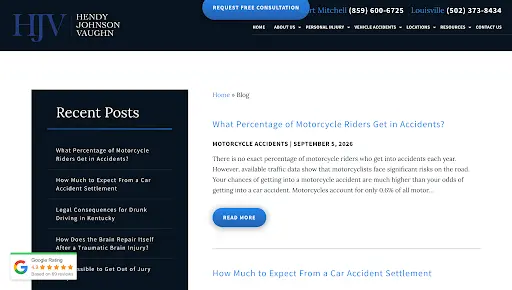
For a law firm, this would mean maintaining an active social media profile and frequently posting on the firm website. HJV Car Accident Personal Injury Lawyers does this by maintaing an up-to-date blog with topics relevant to their audience:
Marketing teams or outsourced providers like agencies or freelancers typically handle this. Work with them to generate a list of sales-qualified leads (SQLs).
Outbound prospecting means reaching out directly to prospects through cold calls, cold emails, LinkedIn outreach, and event networking. This activity targets buyers who aren't searching for you yet but would clearly benefit from what you offer.
Outbound takes more effort and meets more resistance, but it gives you control over exactly who you target, and it’s usually how you start building client relationships.
You could use AI tools as part of this. But we wouldn’t recommend relying on any of these 100% because B2B buyers are valuing personal, hyper-tailored connections and interactions far more than AI-generated emails.
Let’s look at the three core prospecting methods, followed by some useful tips and guidelines.
Here are three of the most common and successful outbound sales prospecting methods.
High-intent SEO comes down to knowing who your audience is and capturing prospective clients when they are most likely to be looking for a solution.
For a law firm like Marzzacco Niven & Associates, for example, ideal clients are people in Pennsylvania who have recently been in an accident.
One way they can improve intent targeting is by selecting the right keywords for their advertisements.
For example, "car accident lawyer in Harrisburg" or "workers comp attorney PA" would be keywords people use right after an accident.
The next step is to build localized landing pages for each term so clients land on the right page.
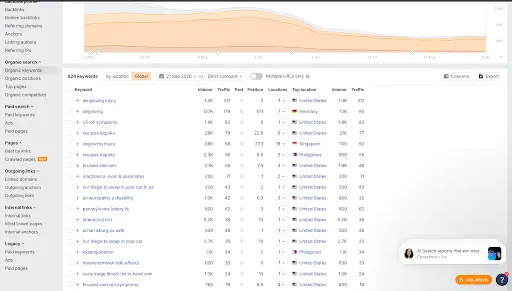
To see what is working for other companies, you can visit a competitor’s website, add the URL into a platform like Ahrefs, and see which keywords they are ranking for in the paid keywords or ads section.
You could also go to your own website’s list of organic keywords to see what you are already ranking for ideas.
LinkedIn is the natural hunting ground for B2B selling.
LinkedIn Sales Navigator lets you filter by exact job title, company size, seniority, and growth indicators, so your list closely matches your ICP. You don’t need to pay for this, or other prospecting tools, but it could make your work easier.
Timing matters as much as targeting.
Watch for trigger events, such as a prospect starting a new role, the company raising funding, or a run of new job postings. These moments create a natural reason to reach out.
Sharing useful content and joining relevant conversations also strengthens credibility before you send a pitch.
Data cited by Rain Group suggests that more than 8 in 10 buyers (80%+) check a potential vendor's LinkedIn presence before replying to outreach, so your profile is part of your pitch.
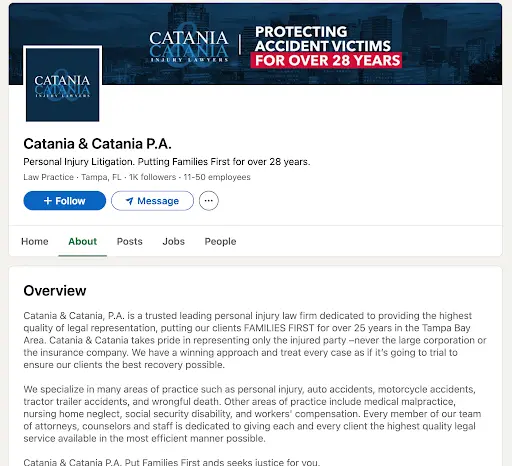
Firms like Catania & Catania optimize their LinkedIn for prospective clients for this reason.
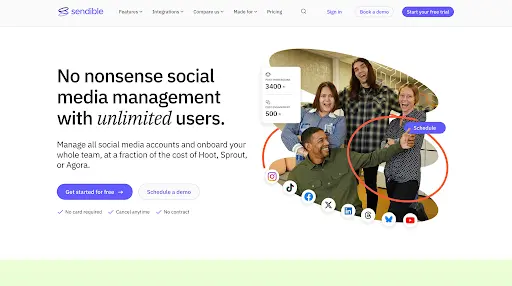
Beyond building and maintaining your firm’s social media profiles, using a platform like Sendible to create and schedule posts lets firms ramp up their efforts.
Cold email is cheap, fast, and scalable, but only if it doesn’t read like a mass copy-and-paste or AI-generated sequence.
Account-based emailing works one-to-one or one-to-few. Each message references a specific challenge or development at the prospect's company, such as a recent product launch, a post they wrote, or a market they just entered.
Cold calling still works, partly because of inbox overload (both email and LinkedIn DMs).
Cognism's research suggests roughly 7 in 10 buyers accept cold calls, and it usually requires about three attempts to reach someone. The phone also lets you show more personality than email does. In some sectors, like the legal profession, cold calling may be restricted in specific states, so check beforehand.
The best version is warm-cold calling. Before you call, check the prospect's website, recent news, or LinkedIn activity so you sound informed.
Use a pattern interrupt as your opener, a talkative line that respects their time and goes straight to a specific business pain. Something like "I'll be brief, and you can tell me if I'm off base" will get a better hearing than a scripted introduction.
Here’s our recommended step-by-step process, followed by five tips for sales prospecting success.
Define your ICP. Describe the companies and people most likely to buy, covering industry, company size, location, challenges, and buying behavior. Review it every quarter, because the best-fit customer often turns out to be different from the one you assumed.
Research and build your list. Use LinkedIn, AI tools, event attendee lists, and data providers. Accurate contact data, especially verified emails and direct phone numbers, saves enormous time.
Qualify. Check fit, authority, budget, and priority before you invest effort.
Choose your channels. Match them to where your buyers actually spend time.
Personalise. Reference something real about the person or company.
Write short, value-led messages. Focus on how you solve their problems, not your feature list.
Make contact. Following up after the first contact is so important. Sending roughly four to nine follow-ups is more useful and more likely to succeed than sending only one message. As long as each one adds something new rather than just "bumping" the thread.
Measure and refine. Track activity metrics (calls, emails sent) and outcome metrics (meetings booked, meetings held, qualified opportunities). Without measurement, you cannot tell what is working.
Some principles separate reps and founders who fill their pipeline from those who spend their days on unanswered messages.
#1 Map the buying committee
B2B purchases rarely hinge on one person. Identify the following persona types:
The champion (the day-to-day user who wants the change)
The decision-maker (who holds the budget)
The influencers (who shape opinion, such as RevOps, IT, or legal).
#2 Lead with peer proof
Clients trust evidence and want to know what happened for similar companies. This often includes case studies on landing pages for firms optimizing for conversions.
Anderson Injury Lawyers, a firm in Dallas, includes examples of cases won alongside awards and recognition they have received in the past.

#3 Start smaller and sharper
A tightly qualified list of 300 prospects will usually beat a mega list of 30,000.
#4 Use trigger events and intent signals
Funding rounds, leadership changes, mergers, and hiring surges all suggest a company's priorities are shifting. Reaching out then makes your message feel timely.
Prospecting is the foundation of the sales process. It fills the pipeline, focuses effort on the right buyers, and teaches you about your market. In B2B, it works best when it is:
Targeted: built around a clear, regularly updated ICP (within the context of your SOM).
Hyper-personal: based on real research into the people you need to reach, and the specific company.
Multi-persona: aimed at the whole buying committee, not one contact.
Multi-channel: combining LinkedIn, email, phone, and events.
Measured: tracked, tested, and refined continuously.
Master those five habits and prospecting becomes less about chasing strangers and more about starting relevant conversations at the right time with the right people.