Ignite Global is a leader in hiring, motivating and retaining top talent with management capability employee engagement, productivity and retention candidate.
future of work, The Great Resignation
9600 Great Hills Trail, Suite 150W Austin TX 78759
Ignite Global is a leader in hiring, motivating and retaining top talent with management capability employee engagement, productivity and retention candidate.
future of work, The Great Resignation
9600 Great Hills Trail, Suite 150W Austin TX 78759
Ignite Global is a leader in hiring, motivating and retaining top talent with management capability employee engagement, productivity and retention candidate.
future of work, The Great Resignation
9600 Great Hills Trail, Suite 150W Austin TX 78759
As I mentioned in yesterday’s post, I am currently fielding 2 questions from clients in Australia and the US about the skills shortage.
The first…
Now that the borders are open in Australia how long will it be before our skills shortage abates?”
I answered this yesterday.
I’ll address the second question today.
The upcoming US recession will surely help the skills shortage (and put realign candidates’ expectations), right?”
To answer this we need to go back in time. You’ve undoubtedly heard the term “The War for Talent” but do you know where that came from? It was a report from McKinsey & Company about the upcoming global skills shortage – written in 1997!!!
So the skills shortage is a challenge that we’ve seen coming for a very very long time. Korn Ferry (by memory but it may have been Manpower, don’t quote me on the source but the numbers are accurate) wrote in 2014(ish) that by 2025 we were expecting a global skills shortage of up to 85 million people (and 20 million won’t have the right skills to be employed as technology changes the shape of our roles.
So, if the US (and/or the rest of the world) goes into recession will the skills shortage go away? Maybe – in certain industries – for a period of time.
But this is part of a larger, global trend that is due to declining birth rates, the declining workforce participation rates (in some countries) and the reshaping of roles due to technology, as I mentioned above.
9600 Great Hills Trail, Suite 150W Austin, TX 78759, UNITED STATES
About
In 2009 CEO and founder Kim Seeling Smith started Ignite Global after deciding that instead of being paid to put bums in seats (working as a recruiter for the 15 years prior to that) she wanted to help More
If you follow me on here you know that I’ve been through quite the journey with video, which is why I’m so excited about the next Professional Speakers Australia – PSA national event with video creation and marketing growth specialist Justin Brown.
Justin will share insider secrets on how to optimise your videos on YouTube so your content generates views for years after you upload it.
You’ll take away:
• How to structure your content to ‘bake-in’ key triggers that let YouTube know YOUR video is the one they should be promoting
• Keys to maximising watch time so your target audience sees more of you in action
• How to drive more engagement for even better results
Justin has a huge online community and this is your chance to get direct access to him.
Read More: https://www.igniteglobal.com/2022/06/psa-national-webinar-how-to-create-and-use-amazing-youtube-content/
I’m cheating a bit. Last week I promised to post 3 things that I found inspiring every Friday. Today I’m posting 20.
Last night I attended Consult Australia‘s FutureNet awards night for NSW (magnificently convened by Linda Gaunt). It was a COVID-safe event held in the Grand Ballroom of the ICC in Sydney. There were only 30 people in attendance including 19 of the 20 participants, all 4 of the mentors and the facilitators, like me, who...
Friday funny. You’ve heard of the KISS Principle, right? Keep It Simple Stupid (or I prefer Silly). Now I’d like to introduce the KSS Principle!
KISS Principle
My clients have told me for years that one of my superpowers is breaking down complex concepts and making them simple.
In fact, one of the best testimonials I’ve ever gotten came from Mike Saxton, who said,
A few months ago, I was leading a training session, and I mentioned the KISS Principle…and one of the participants said, you should rename it the KSS Principle for Kim Seeling Smith. We had a good laugh, but now I find myself saying it frequently.
I’m curious, what has your experience been with implicit bias training?
Having spent 15 years working as a professional recruiter and 11 years teaching hiring managers how to hire more effectively and efficiently I’ve always felt that implicit bias training was a waste of time.
There is more and more research now backing up my gut feel. Here are two articles that unpack this pretty nicely.
Even worse, there is consistent evidence that bias training done the “wrong way” (think lukewarm diversity training) can actually have the opposite impact, inducing anger and frustration among white employees. What this all means is that, despite the widespread calls for implicit bias training, it will likely be ineffective at best; at worst, it’s a poor use of limited resources that could cause more damage and exacerbate the very issues it is trying to solve.
Read More: https://www.igniteglobal.com/2020/08/the-problem-with-implicit-bias-training/
Talking reimagining talent acquisition with Nate Hewitt of Sapia.ai on their Pink Squirrels Podcast.
We had a very spirited discussion around:
What companies are getting wrong with talent acquisition right now
How companies stand out against their talent competitors (even with little or no budget)
How to think differently about the roles they are filling to access more candidates.
Talking reimagining talent acquisition with Nate Hewitt of Sapia.ai on their Pink Squirrels Podcast. We had a very spirited discussion around: 🔹 What companies are getting...
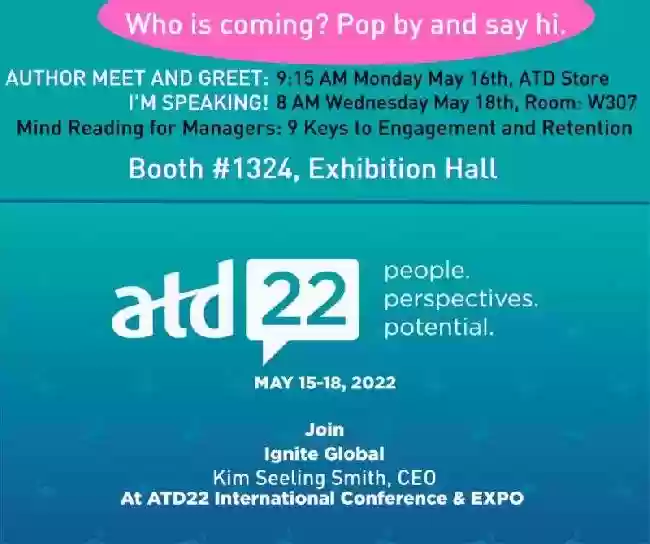
Are you coming to ATD 2022, the world’s largest talent development conference? You can attend live in Orlando, or beam in virtually. If you’re on site pop by to say hi!
𝗔𝘂𝘁𝗵𝗼𝗿 𝗺𝗲𝗲𝘁 𝗮𝗻𝗱 𝗴𝗿𝗲𝗲𝘁: 9:15 Monday, May 16th, ATD Store
𝗜’𝗺 𝘀𝗽𝗲𝗮𝗸𝗶𝗻𝗴: 8AM Wednesday, May 18th, Room W307 (check for last-minute room switches