While the mainstream digital audience remains crowded around a handful of high-profile, general-purpose chatbots, a quieter and far more disruptive revolution is taking place.
In developer forums, private Discord servers, and early-mover professional circles, a specialized layer of artificial intelligence has matured on the open web.
These targeted, single-purpose platforms do not merely chat - they execute specialized, complex disciplines with a precision that was historically locked behind years of professional training and expensive hardware.
This comprehensive analysis explores the strategic shift toward specialized AI engines in 2026, details the ten under-the-radar platforms driving this change, and provides a tactical roadmap for professionals looking to secure an invisible, compounding competitive advantage before these tools become common standards.
For the past several years, the public’s understanding of artificial intelligence was defined by generic text prompts and chat interfaces.
However, in 2026, we are witnessing what technology strategists call "specialized capability redistribution".
Rather than fighting over which chatbot is marginally smarter, early adopters have quietly migrated toward single-purpose tools designed to master specific tasks.
This transition is driven by two fundamental technological dynamics:
"Skill collapse" refers to the automation of highly technical, mechanical tasks that once required years of formal training.
When formatting, typesetting, vocal tuning, or layout alignment are fully handled by an AI engine in seconds, the technical barrier to entry collapses.
The professional’s role shifts from a mechanical executor (handling the "how") to a logical director (shaping the "why").
The unpublicized efficiency gap between early adopters and the general public creates an asymmetric advantage.
When an individual can produce in 10 minutes what their competitor or colleague spends an entire day building, they possess a massive, unannounced lead.
Because this leverage is invisible from the outside, it compounds over time, resulting in superior preparedness, higher-quality outputs, and reclaimed cognitive focus.
Humans process visual information 60,000 times faster than written text.
In professional communication, the individual who can translate dry, complex ideas into immediate visual structures holds a disproportionate power to persuade, teach, and sell.
Yet, knowledge workers waste an average of four to six hours weekly on administrative presentation labor - fiddling with layouts, margins, and boxes rather than focusing on strategic substance.
Three key platforms are systematically dismantling this bottleneck:

Visualizing Logical Concepts Instantly
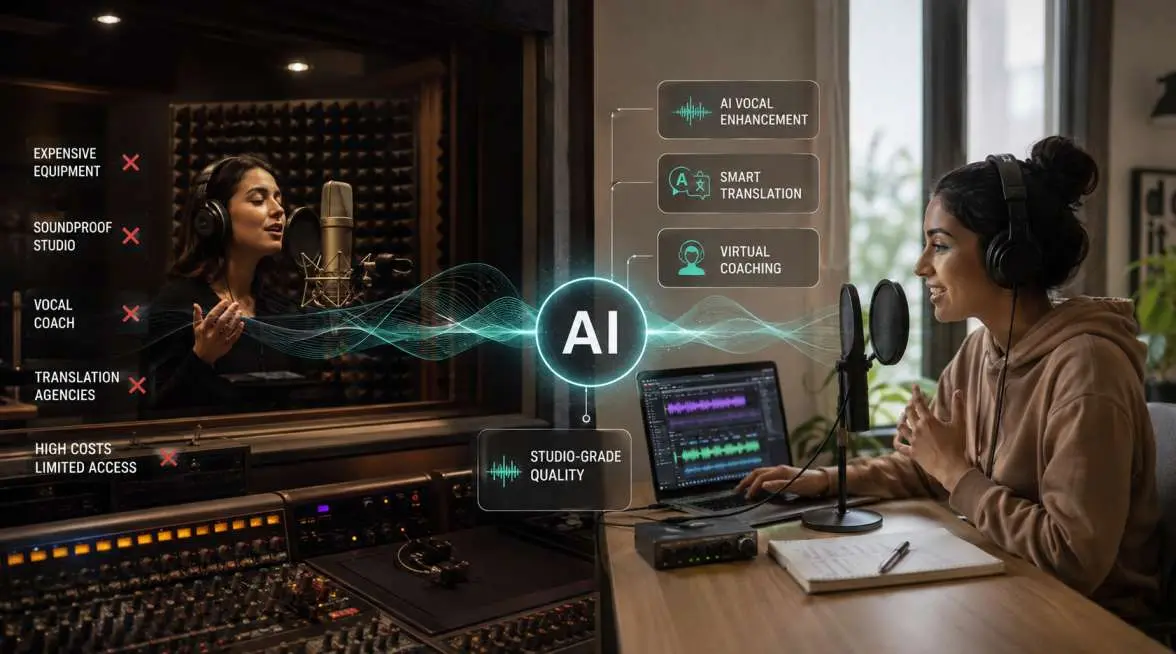
The barriers surrounding vocal production and studio-grade audio have traditionally been among the most expensive to cross.
From high-end microphones and soundproofed booths to vocal coaches and translation agencies, professional-grade sound was restricted by geographic and financial limitations.
Specialized AI has democratized this field, completely altering the economics of sound.
Advanced Digital Sound and Vocal Synthesis
We are currently living in an era of severe information overload. More than 4 million peer-reviewed scientific papers are published annually, with the total volume of academic literature doubling approximately every nine years.
For professionals, wading through this ocean of data to find reliable, verified facts has become a crushing cognitive burden.
Traditional search engines, designed to serve ad-laden links and SEO-optimized clickbait, frequently worsen this issue.
Three specialized platforms have emerged to restore attention and deliver clear, verified truths:

Connecting Complex Academic Research Nodes
While knowing about these tools individually is valuable, the true "invisible edge" comes from understanding how to stitch them together into a high-performance workspace, while managing compliance and cost.
The most successful professionals do not use these tools in isolation. Instead, they build continuous pipelines that dramatically multiply their speed-to-market. Here is a proven, multi-tool workflow:
Phase | Specialized Platforms | Strategic Objective | Expected Output |
Phase 1: Research | Perplexity AI Consensus | Gather live web data & peer-reviewed evidence | Structured, cited raw research |
Phase 2: Synthesize | NotebookLM | Incorporate private documents & generate core outlines | Unified strategic brief |
Phase 3: Visualize | Napkin AI | Convert text logic into structured visuals | Flowcharts, Venn diagrams, and logical concept maps |
Phase 4: Output | Gamma Tome | Compile into living pitch decks or interactive sites | Immersive presentations and responsive web pages |
Table: The Four-Phase Specialized AI Workflow Pipeline
To help you choose the right platform for your needs, we have compiled an essential reference chart detailing standard tiers and security considerations:
Category | Platform | Key Competitors | Standard Tiers (Free vs. Paid) | Data Privacy & Security Compliance |
Visual Design | Napkin AI | Canva, Microsoft Copilot, Beautiful.ai | • Napkin: Free Beta; premium tiers planned. | • Gamma & Tome: Standard encryption (SOC 2 Type II compliant). Data is generally not used for model training on paid tiers. |
Advanced Audio | Eleven Labs | Play.ht, Murf.ai, Stable Audio | • Eleven Labs: Free (limited characters); Paid starts at $5/mo. | • Eleven Labs: Requires voice ownership verification for high-tier cloning. |
Advanced Research | Perplexity | Google Scholar, ChatGPT Plus, Claude Pro | • Perplexity: Free (standard search); Pro ($20/mo) unlocks advanced models. | • NotebookLM: Extremely secure; Google explicitly states that uploaded private documents are private and never used to train public models. |
Table 2: 2026 Specialized Tool Matrix: Competitors, Pricing, and Security Compliance
The advantage of knowing about these tools is highly time-sensitive.
As specialized AI tools integrate into standard operating software, the productivity gap will naturally close, and the competitive playing field will level out.
To capitalize on this narrow window, consider the following recommendations: