
| Ad Type | I am offering |
Introduction
Data is one of the most valuable resources for modern businesses. From banking and healthcare to retail, e-commerce, and financial services, organizations generate enormous volumes of data every day. However, raw data becomes useful only when it can be collected, processed, transformed, and delivered in a meaningful format. This is where Azure Data Engineers play an important role.
If you want to build a career in cloud data engineering, Azure Data Engineer Training in Hyderabad at Version IT can help you develop the technical skills required to understand modern data platforms and data processing workflows. Learning Microsoft Azure data services, SQL, data integration, and cloud-based processing can help you prepare for practical data engineering responsibilities.
Version IT's training approach focuses on understanding important technologies, developing hands-on skills, and working through practical project scenarios. Whether you are a fresher, a software professional, a database developer, or someone planning to move into cloud data engineering, structured training can help you build a strong foundation.
Why Choose Azure Data Engineering as a Career?
Organizations increasingly rely on cloud platforms to manage growing volumes of structured and unstructured data. Microsoft Azure provides services that help businesses build scalable data pipelines, process large datasets, and support analytics solutions.
Azure Data Engineers help design, implement, and maintain data systems that move information from different sources into centralized storage and analytics platforms.
Some important responsibilities of an Azure Data Engineer include:
These responsibilities make data engineering a relevant career path for professionals interested in databases, programming, cloud computing, and data analytics.
What You Will Learn in Azure Data Engineer Training at Version IT
A well-structured Azure Data Engineering course should combine fundamental concepts with practical exercises. The following technologies are important areas to explore during your training.
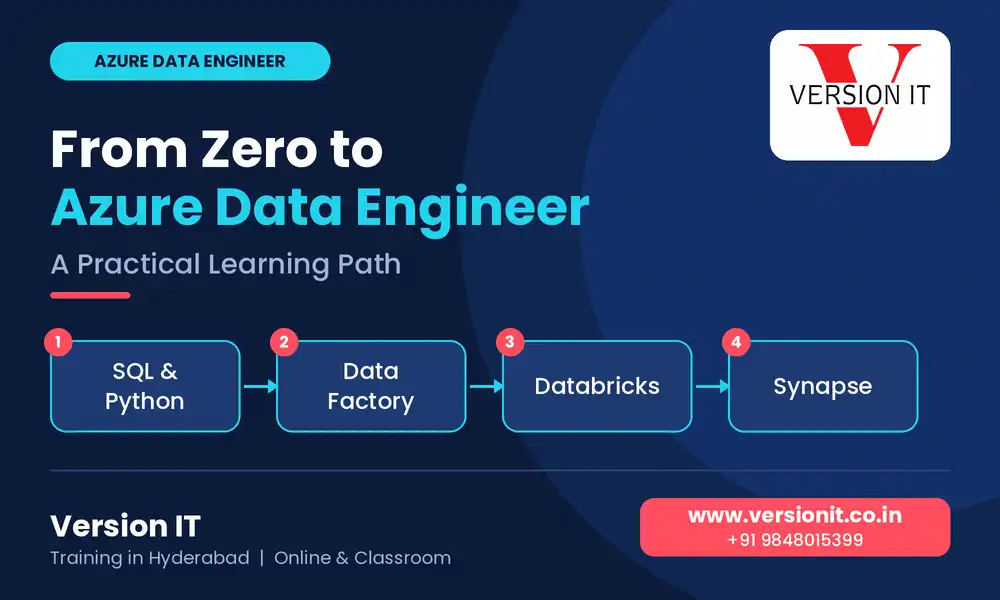
1. Microsoft Azure Fundamentals
Start by understanding the basics of cloud computing and the Microsoft Azure environment. Learn about resource groups, storage accounts, access management, and the services used to build cloud-based data solutions.
This foundation helps you understand how different Azure services work together within a data engineering architecture.
2. Azure Data Factory
Azure Data Factory is a cloud-based data integration service used to create and manage data pipelines.
During practical learning, you can explore:
These skills are useful for understanding how data moves between source systems and destination platforms.
3. Azure Databricks and Apache Spark
Azure Databricks provides a collaborative environment for data engineering and large-scale data processing using Apache Spark.
Important learning areas include:
Practical experience with Databricks and PySpark can help you understand how modern data platforms process large datasets efficiently.
4. Azure Synapse Analytics
Azure Synapse Analytics brings together data integration, data warehousing, and analytics capabilities.
Explore concepts such as data warehousing, SQL-based data analysis, analytical workloads, and integrating data from multiple sources. Understanding these concepts helps you learn how processed data can support business reporting and analytical applications.
5. SQL and Data Transformation
SQL remains an essential skill for data engineering. Developers use SQL to retrieve, join, aggregate, validate, and transform information stored in relational databases.
Focus on:
Professionals with existing SQL experience can build on these skills while learning cloud data integration and distributed processing.
6. Data Lake Storage and ETL/ELT
Azure Data Lake Storage provides scalable storage for data engineering workloads. Learn how data can be organized into raw, processed, and curated layers.
Understand the differences between ETL and ELT, data formats such as CSV, JSON, and Parquet, and the importance of managing data quality, security, and access permissions.
Real-Time Projects for Practical Learning
Real-world project practice helps connect individual technologies into a complete data engineering workflow. At Version IT, prospective learners should confirm the current project syllabus and the specific hands-on exercises included in the course.
Here are examples of project scenarios that are useful for Azure Data Engineer training.
Project 1: Retail Sales Data Pipeline
Build a sample data pipeline that collects retail sales information from CSV files and a relational database. Use Azure Data Factory to ingest the data, apply transformations using SQL or Databricks, and store the processed results in a data lake.
The project can include data validation, duplicate removal, scheduled execution, and pipeline monitoring.
Project 2: Customer Data Processing with PySpark
Work with a sample customer dataset containing incomplete records, duplicate entries, and inconsistent formats. Use PySpark to clean the data, apply transformation rules, and prepare the output for analytical use.
This scenario helps learners understand distributed data processing and data quality management.
Project 3: Incremental Data Loading
Create a workflow that processes newly inserted or modified records instead of reloading an entire dataset every time. Explore watermark columns, timestamps, change tracking, and incremental pipeline logic.
This is a useful scenario for understanding how data pipelines can reduce unnecessary processing.
Project 4: End-to-End Cloud Data Engineering Solution
Combine data ingestion, cloud storage, transformation, and analytics into a single workflow. Load sample business data, process it using Azure services, and make the curated data available for SQL-based analysis.
Document the architecture, data flow, transformation logic, error-handling approach, and validation results. A well-documented project can also help you explain your technical decisions during interviews.
Who Can Join Azure Data Engineer Training?
Azure Data Engineering can be suitable for learners from different technical backgrounds.
Fresh graduates: Students with computer science, information technology, or related educational backgrounds can start with cloud and database fundamentals.
SQL developers: Database developers can extend their existing SQL knowledge into data integration, cloud storage, and distributed processing.
ETL developers: Professionals working with data extraction and transformation can explore cloud-based pipeline development.
Software professionals: Developers interested in data platforms and cloud technologies can expand their technical skill sets.
IT professionals planning a career transition: Learners moving toward data engineering should focus on SQL, Python, cloud services, and project-based practice.
Prior knowledge of SQL and basic programming can be helpful, although the required starting level depends on the course structure.
Career Opportunities after Azure Data Engineering Training
After developing the necessary technical skills and practical experience, learners can explore roles such as:
Job requirements vary by employer, experience level, and project environment. Some positions require additional knowledge of Python, advanced SQL, data modeling, orchestration, version control, security, and cloud architecture.
To strengthen your profile, build projects that demonstrate your ability to design pipelines, process data, handle failures, and explain the reasoning behind your technical choices.
Why Consider Version IT in Hyderabad?
Choosing a training institute involves more than comparing course titles. Learners should evaluate the curriculum, instructor expertise, practical exercises, project depth, and support available during the learning process.
When exploring Azure Data Engineer Training at Version IT, consider these factors:
Confirm the latest course details directly with Version IT before enrolling.
Frequently Asked Questions
1. What is Azure Data Engineer Training?
Azure Data Engineer Training teaches learners how to build and manage cloud-based data pipelines using Microsoft Azure services, SQL, data integration tools, and data processing technologies.
2. Is SQL knowledge necessary for Azure Data Engineering?
SQL is an important skill for querying, transforming, and validating data. Knowledge of SQL provides a useful foundation, particularly for database developers and ETL professionals.
3. Does Azure Data Engineer training include real-time projects?
Project availability depends on the institute's current curriculum. Ask Version IT to confirm the included projects, hands-on lab access, and whether learners complete an end-to-end implementation.
4. Can freshers learn Azure Data Engineering?
Yes. Freshers can start with SQL, Python fundamentals, cloud concepts, and basic data processing before progressing to pipelines and advanced Azure services.
5. What jobs can I pursue after this course?
Depending on your skills and experience, you can explore Azure Data Engineer, Junior Data Engineer, ETL Developer, Data Pipeline Developer, and related cloud data roles.
6. How do I choose the right Azure Data Engineering course in Hyderabad?
Compare the syllabus, trainer experience, practical lab access, project work, training schedule, and career support. Choose a program that provides sufficient hands-on practice rather than focusing only on theoretical explanations.
Start Your Azure Data Engineering Learning Journey
Cloud data engineering combines database knowledge, programming, data integration, and analytical processing. Developing these skills can help you prepare for opportunities in modern data platforms and cloud-based projects.
If you are looking for Azure Data Engineer Training in Hyderabad, explore the course offerings at Version IT and review the current syllabus, project work, and hands-on learning options. With consistent practice, a solid understanding of SQL and Python, and well-documented projects, you can work toward building the skills expected in data engineering roles.
Take the next step: Visit Version IT to enquire about Azure Data Engineer training, available batches, course modules, and practical project opportunities.



 Australia
 Singapore
 United Kingdom
 United States
 Germany
 South Africa
 New Zealand
 Nigeria
 Canada
 France
 Spain
 Italy
 Ireland
 UAE