
| Ad Type | I am offering |
Every app you use, from online shopping to banking, runs on data. Someone has to collect that data, clean it, move it and make it ready for analysis. That person is the data engineer, and companies in Hyderabad are hiring for the role across IT services, product firms and startups.
If you are a fresher, a support engineer, or a professional from another IT stream, the question is usually the same: where do I start? This guide lays out a practical path, step by step, to go from zero to Azure Data Engineer.
Who Is an Azure Data Engineer?
An Azure Data Engineer designs and builds data pipelines on Microsoft Azure. You pull data from different sources, transform it, store it in the right place and keep everything running smoothly. Analysts and data scientists then use the data you prepare.
Day to day, you might copy data from a SQL database into a data lake, clean it with Databricks, and load it into a warehouse for reporting. You also schedule these jobs and fix them when they fail.
Step 1: Build Your Foundation
You do not need to be an expert before you begin, but a few basics will make everything easier.
Spend the first few weeks here. Weak SQL is the most common reason beginners struggle in interviews.
Step 2: Understand Cloud and Azure Basics
Before touching pipelines, get comfortable with the Azure portal. Learn about resource groups, subscriptions, storage accounts and access control. Understand how Azure Data Lake Storage Gen2 organizes files, since most projects store raw and processed data there.
Step 3: Learn Azure Data Factory
Azure Data Factory (ADF) is the tool most companies use to move and orchestrate data. Focus on:
Build a small project: copy data from a source, transform it, and load it to a destination on a daily schedule.
Step 4: Master Databricks and PySpark
Big data processing is where data engineers stand out. Azure Databricks lets you process large volumes of data using Apache Spark. Learn:
The medallion approach (Bronze, Silver, Gold layers) is widely used in real projects, so practise building it.
Step 5: Explore Synapse Analytics and Data Warehousing
Once data is clean, it needs to be stored for reporting. Azure Synapse Analytics gives you a place to build data warehouses and run large queries. Learn dimensional modelling, including fact and dimension tables and star schemas. This is a favourite topic in interviews.
Step 6: Add Streaming and Supporting Tools
Not every project is batch only. Get an introduction to real-time data with Event Hubs and Stream Analytics. Also learn Azure Key Vault for managing secrets, and the basics of Git and CI/CD so you can work like a team member, not just a learner.
Step 7: Build Real Projects
Certificates alone do not get you hired. Projects do. Aim for at least one end-to-end project that covers:
Be ready to explain every decision in your project. Interviewers care more about your reasoning than the tools you name.
Step 8: Prepare for Interviews and Certification
Revise SQL, Python, Spark, and ADF scenarios. Practise explaining your project in simple words, and prepare a clear resume with your tools and project details. If you want extra credibility, consider the Microsoft Azure Data Engineer certification (DP-203 or the current equivalent exam, so check Microsoft's site for the latest details).
How Version IT Supports Your Journey
Learning alone is possible, but it is slow, and it is easy to get stuck on small errors. At Version IT in Hyderabad, the Azure Data Engineer training is designed around this same practical path:
The goal is simple: by the end, you should be able to build a pipeline on your own and explain it with confidence in an interview.
Final Thoughts
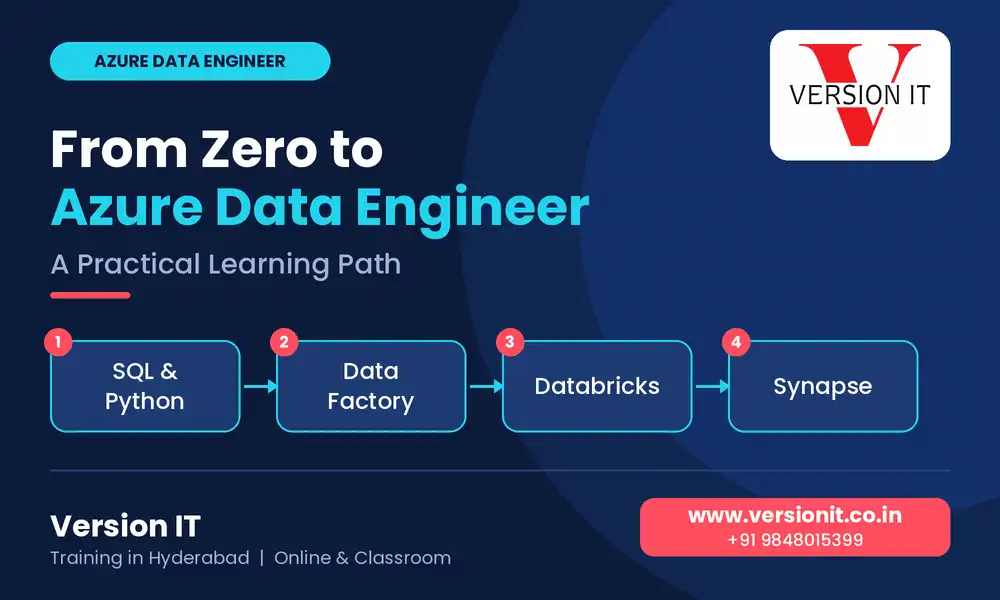
Becoming an Azure Data Engineer Training in Hyderabad is not about learning every tool at once. Start with SQL and Python, move to Azure basics, then Data Factory, Databricks and Synapse, and finish with projects. Follow the steps in order and stay consistent, and the path from zero to job-ready becomes clear.
Ready to start your Azure Data Engineer journey in Hyderabad?
Visit www.versionit.co.in or call +91 9848015399 to book a free demo session.


 Australia
 Singapore
 United Kingdom
 United States
 Germany
 South Africa
 New Zealand
 Nigeria
 Canada
 France
 Spain
 Italy
 Ireland
 UAE