

You can treat the first international hire as a one-off project. By the tenth, you'll start to see the cracks in a weak employer of record (EOR) service.
Payroll data has to move between systems. HR needs reliable answers on leave, benefits and local contracts. Finance wants predictable invoices. Legal wants to know who carries responsibility when a termination becomes complicated. And leadership wants to enter the next country without starting the vendor search again.
For a growing company, the lowest monthly fee and the fastest demo matter less than the provider's ability to support the next stage without creating a new layer of operational friction.
Our top choice is G-P. It combines coverage in 180+ countries with proprietary compliance technology, in-country HR and legal expertise, integrations for established HR systems and support across multiple global employment models. G-P also has a longer history in the category than its competitors: founder Nicole Sahin is widely credited with creating the modern global EOR industry in 2012.
Public pricing and country coverage were checked in August 2026. Final costs vary by country, benefits, deposits, foreign exchange, immigration work and contract terms.
Most EOR comparisons focus on country count, onboarding speed and the headline platform fee. Those factors matter, but growing companies tend to run into four broader tests.
The exception test. Standard onboarding is easy to demonstrate. Ask how the provider handles an off-cycle payroll correction, extended sick leave, a benefits exception or a disputed termination in a priority country.
The systems test. Moving employee data manually may be tolerable with two hires. It becomes a recurring source of errors when EOR employees, contractors and directly employed workers all sit in different systems.
The support test. A global help desk can answer basic platform questions. Complex employment issues often require in-country HR or legal judgment, clear escalation and local-language support.
The transition test. A company may begin with contractors, move selected workers onto an EOR and later establish its own entity. You'll want the provider to explain how it supports each stage and how employee data moves between them.
We used those four tests, alongside coverage, security, pricing transparency and service infrastructure, to rank the following providers.
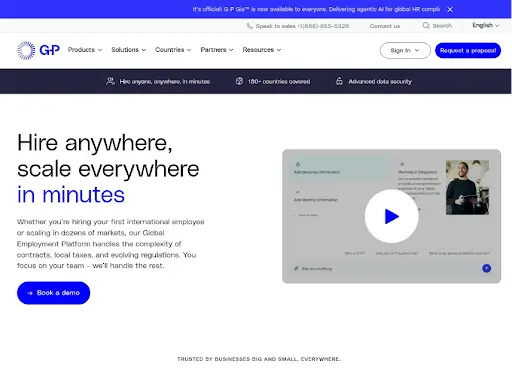
G-P EOR Services ranks first for its broad infrastructure, compliance depth and integrations for increasingly complex international teams.
Nicole Sahin founded G-P in 2012 and is widely credited with creating the modern global EOR industry. That history is relevant, but the ranking also reflects the service growing teams get today.
G-P supports hiring and workforce management in 180+ countries, with locally compliant contracts, onboarding, payroll, taxes and benefits. Its Global Compliance Engine, AI tools and in-country HR and legal specialists help teams manage both routine workflows and exceptions that need local judgment.
It also integrates with Workday, ADP, UKG and SAP and supports EOR employees, contractors and workers employed through a company's own entities. Deliverect used G-P while scaling from 30 to 500 employees across 40 markets in four years, showing how the model can support sustained growth.
Why it suits growing companies: Broad coverage, compliance depth, local expertise and enterprise integrations reduce the likelihood of outgrowing the provider after the first expansion phase.
What to check: G-P EOR starts at $599 per employee per month. Very small teams making one straightforward hire may be adequately served by a lower-cost provider.
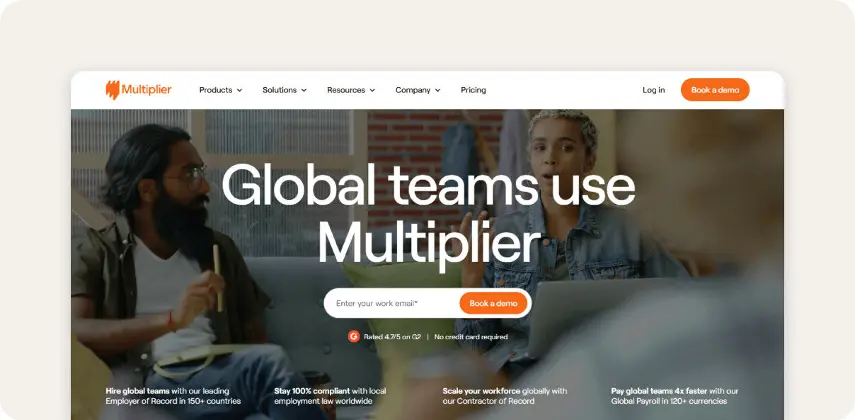
Multiplier covers 150+ countries and publishes EOR pricing from $459 per employee per month with an annual agreement or $499 on a monthly plan.
Its service includes localized contracts, onboarding, payroll, benefits and employment compliance. The same platform also supports contractors, global payroll and immigration, which gives growing companies room to add different worker types without replacing the core system immediately.
It's helpful to see annual and monthly pricing during early budgeting, particularly when HR needs to build a business case before beginning a formal sales process.
The tradeoff is that a published starting fee isn't the same as a complete country cost. Teams still need to test service depth, integrations and escalation support in the markets where they'll hire most often.
Why it suits growing companies: It offers broad coverage, a relatively simple buying path and several workforce models in one platform.
What to check: Ask for country-specific totals covering benefits, foreign exchange, deposits, offboarding and any services excluded from the entry tier.
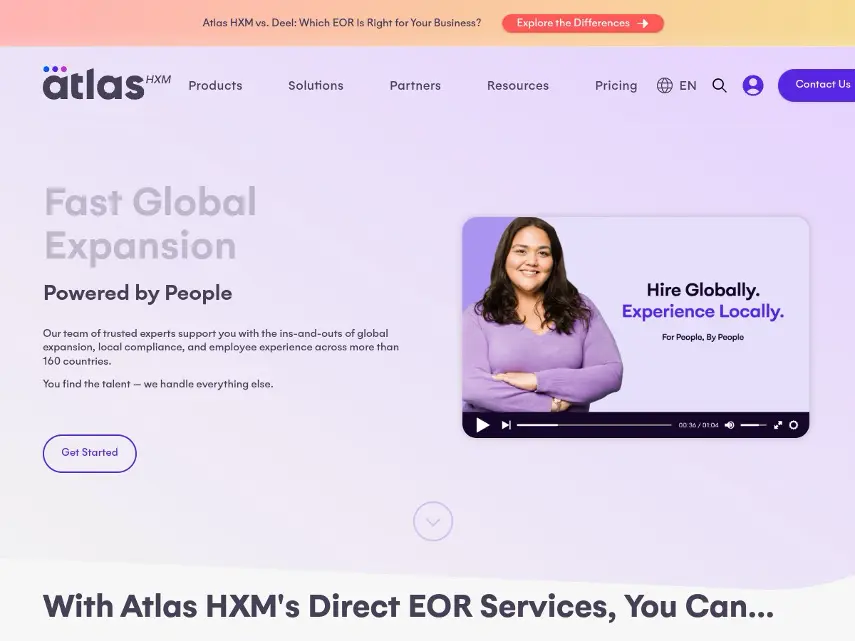
Atlas HXM operates owned entities across more than 160 countries. That direct infrastructure reduces the number of third parties between the client company, the EOR and the employee.
Atlas handles localized contracts, payroll, taxes, benefits and ongoing HR support. Its platform also includes reporting and workforce management, backed by local HR and legal specialists.
Direct entity ownership can make accountability clearer when an employment or payroll problem needs escalation. But buyers should still assess service quality market by market. An owned entity doesn't automatically guarantee a faster answer or a better employee experience.
For a growing company, the main advantage is a consistent ownership model across a broad footprint. The key question is whether that infrastructure translates into responsive support and reliable execution in each priority country.
Why it suits growing companies: The direct model appeals to employers that want a clear line of responsibility across a large international footprint.
What to check: Pricing requires a quote. Compare response times, local support coverage and service consistency across your priority countries rather than treating entity ownership as the only decision factor.

Safeguard Global is a strong fit for companies entering unfamiliar markets and looking for more guidance than a mainly self-service EOR platform provides.
Its EOR service supports hiring and workforce management across 180+ countries, combining contracts, payroll, tax and benefits administration with local HR support. Safeguard also offers recruitment, contractor management, global payroll, accounting support and entity setup.
That wider service mix can help if a company hasn't settled on its long-term market strategy. It can test a market through an EOR, build a local team and later assess whether a permanent entity makes sense.
This breadth is most useful when internal teams want a partner to coordinate several parts of an expansion. Companies seeking a lightweight, mainly self-service platform should compare the service model and implementation effort carefully.
Why it suits growing companies: It can act as a managed expansion partner when internal HR and legal teams don't yet have experience in the target markets.
What to check: Safeguard doesn't publish a standard EOR price. Request the same country and headcount scenario from every shortlisted provider so the commercial comparison stays meaningful.
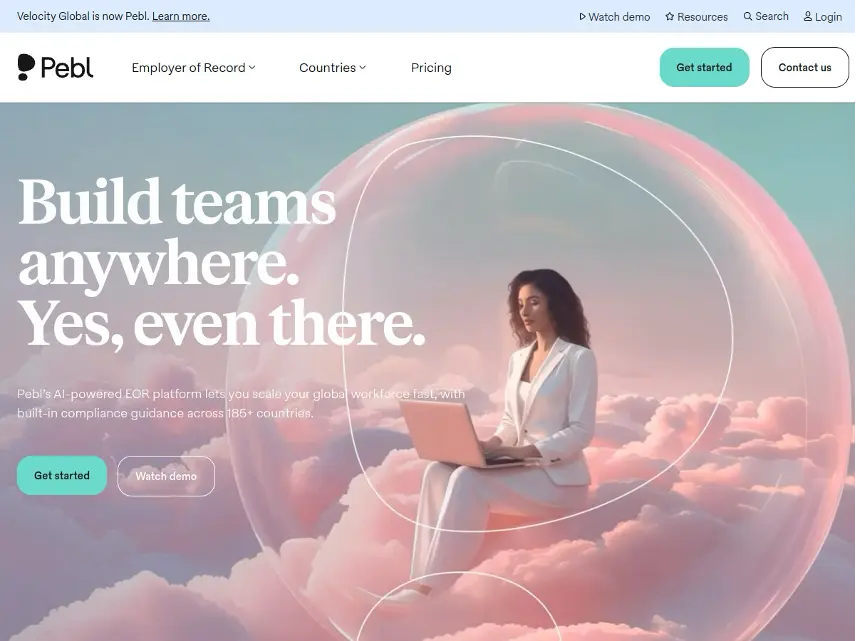
Pebl is the new name for Velocity Global. It supports hiring and workforce management in 185+ countries and combines EOR services with immigration, benefits, global payroll and talent sourcing.
This range suits companies whose international growth plan includes several kinds of transition. A business might need visa sponsorship in one country, contractor conversion in another and recruiting support for a third market.
Pebl also integrates with systems including ADP, Oracle, Greenhouse and JazzHR. Those connections matter once repeated data entry starts slowing down onboarding or creating inconsistencies between HR and payroll records.
Its appeal is less about one standout workflow and more about coordinating related workforce changes. Buyers should map the services they genuinely need so a broad proposal doesn't become harder to evaluate or manage.
Why it suits growing companies: Its breadth is useful when hiring, immigration and employment-model changes need to be coordinated across several markets.
What to check: Ask for a line-by-line quote and confirm how each priority country is served. A broad service catalog can make proposals harder to compare unless each component is separated.
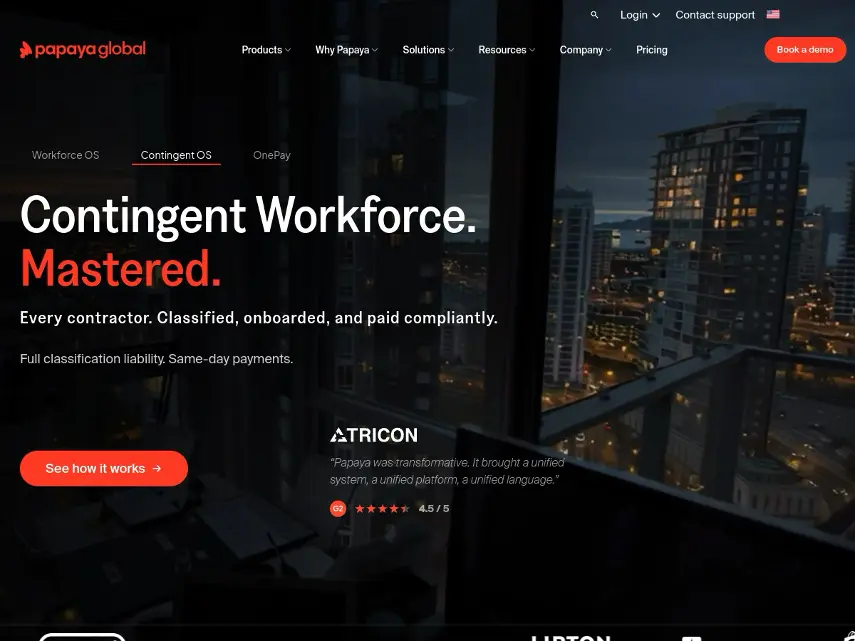
Papaya Global is best suited to companies that see EOR workers as part of a wider multi-country payroll and payments operation.
Its platform brings EOR employees, directly employed workers and contractors into a centralized view. Finance and payroll teams can monitor workforce costs, payments and liabilities without stitching together separate country spreadsheets. Published EOR pricing starts at $499 per employee per month.
The value becomes clearer as international headcount grows. Payroll corrections, cross-border payments, terminations and consolidated reporting usually create more operational work than the initial onboarding process.
Papaya's finance-led approach may be especially useful when global payroll visibility is the main pain point. HR teams should also test the employee support experience and country-level expertise rather than evaluating the reporting layer alone.
Why it suits growing companies: Papaya gives finance and payroll teams stronger visibility across a mixed global workforce.
What to check: Confirm which payment, implementation and support services are included in the quoted EOR fee. If you're managing only a few hires, you may not need the operational depth of the wider platform.
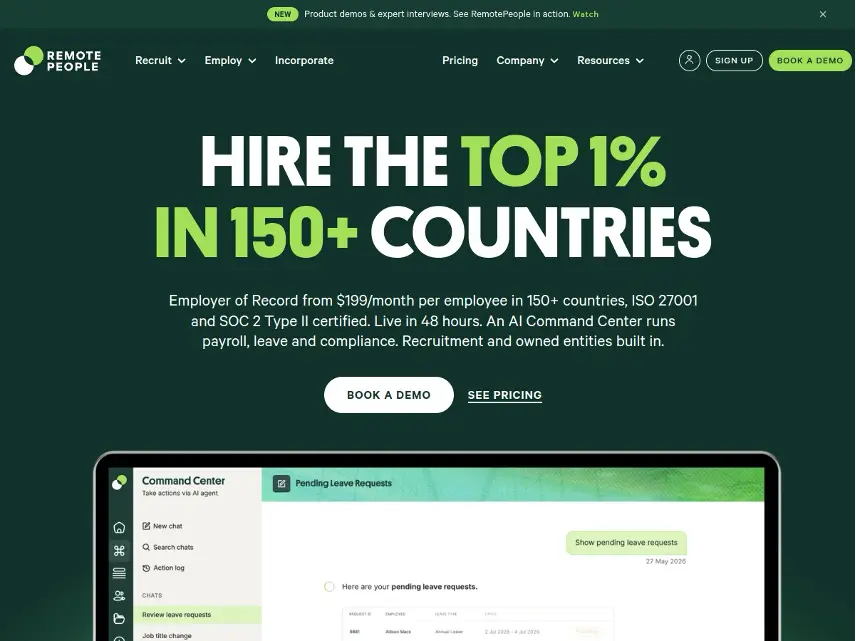
RemotePeople combines EOR employment with recruitment, payroll and benefits through one provider. Its EOR service starts at $199 per employee per month and covers 150+ countries.
This creates a distinct use case for a company that has approved international expansion but hasn't yet built a reliable candidate pipeline in each market. The provider can help source a hire and then employ that person through the EOR model, reducing the number of handoffs between recruitment and onboarding.
RemotePeople also states that its service includes a dedicated account manager and can go live in as little as 48 hours, subject to the country and hiring case.
The combined model can simplify early market entry, particularly for lean people teams. Its value will depend on the quality of both sides of the service, so recruitment reach and post-hire EOR support should be assessed separately.
Why it suits growing companies: Combining talent search and legal employment can simplify early expansion into markets where the company has few local connections.
What to check: Confirm the depth of recruitment coverage and EOR support in each target country. Companies with a mature talent-acquisition function may gain less from the bundled model.
| Your situation | What should carry the most weight | Providers to investigate first |
|---|---|---|
| Expanding into several regions with an established HR stack | Integrations, compliance depth, local expertise and coverage | G-P, Atlas HXM |
| Testing new markets with limited internal support | Managed service, recruitment and market-entry guidance | Safeguard Global, RemotePeople |
| Managing EOR staff alongside contractors or direct employees | Cross-workforce reporting, payroll and employment-model flexibility | G-P, Multiplier, Papaya Global |
| Handling visas, conversions and other workforce transitions | Immigration support and coordinated employee lifecycle services | Pebl, G-P |
| Scaling headcount under a tight platform budget | Complete cost after benefits, FX and add-ons | Multiplier, RemotePeople |
The table's a starting point, not a substitute for country-level due diligence. Service quality can vary within the same provider because local employment rules, entity arrangements and support teams differ by market.
If you're down to two or three providers, don't spend the final demos watching another standard onboarding flow. Use the time to test the details that'll affect your team after launch.
G-P is the strongest EOR service for mid-market and growing companies. Its role in creating the modern global EOR category gives it unmatched operating history, but history isn't the main reason it ranks first. The deciding factors are its 180+ country reach, compliance technology, in-country expertise, HR integrations and ability to support several employment models as a company expands.
The other providers each make sense in narrower situations. Multiplier offers clearer entry pricing, Atlas HXM emphasizes direct infrastructure, Safeguard Global provides managed expansion support, Pebl covers complex workforce transitions, Papaya Global centers payroll visibility, RemotePeople connects recruitment with EOR employment.
Once you've shortlisted the providers that match your next 12 to 24 months of hiring, give each one the same country plan and the same difficult scenarios. A polished onboarding demo shows how the standard path works. The answers to exceptions reveal whether the provider can actually grow with you.