
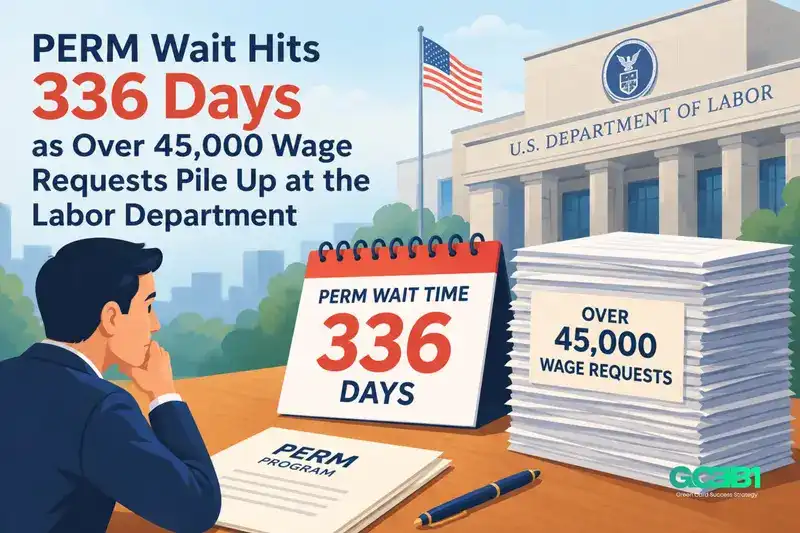
For foreign professionals seeking an employer-sponsored green card, the PERM labor certification is the mandatory first step, and it has become a lengthy wait of its own. The U.S. Department of Labor (DOL) now takes an average of 336 days to review PERM applications, and tens of thousands of prevailing wage requests sit in a queue before that stage even starts. The data does not show a system in free fall. It does show how many separate waits are stacked back to back. Below, our EB-1A consultants explain what H-1B holders and other foreign professionals should know about the PERM timeline.
DOL reported an average of 336 calendar days for PERM analyst reviews completed in August 2026. As of an October 5 update, analysts were working on applications filed in December 2025. WayLit, a firm that tracks the figures monthly, notes this is better than the 372 days it reported previously and the 403 days seen earlier in the summer. Zenith Law Firm points out that it is also well below the 500-plus days cited in earlier coverage.
Still, 336 days covers only one stage: how long analysts take to decide a case. WayLit cautions that the average and the filing month currently under review measure different things and “should not be converted into a forecast for pending cases.”
Employers generally need a prevailing wage determination before filing PERM. This is DOL’s finding of the minimum wage that must be offered for a particular occupation and location. As of August 31, the National Prevailing Wage Center was processing requests received in May 2026. By September 30, it had moved on to June.
The backlog behind that point is substantial. WayLit’s tally of DOL data shows 47,941 PERM wage requests pending on August 31. Roughly 45,155 of those arrived between June and August: 15,781 in June, 15,185 in July and 14,189 in August. Only 2,683 dated from May, and almost none were older.
Another report says more than 45,000 prevailing wage requests were still pending at the end of September. It notes that totals shift as applications are withdrawn or voided, and that the pool includes both PERM and H-1B-related requests (Mwakilishi). Because the counts differ in date and scope, they should not be read as a single series. The same report says Indian nationals, who account for a large share of employment-based applicants, are “disproportionately affected” by long processing times and annual visa caps.
A PERM case has three steps: the wage determination, a recruitment period to test the market for U.S. workers, and DOL’s review of the filed application. WayLit combines current figures into a planning scenario of roughly 16 to 18 months from wage request to certification, assuming no audit:
Other practitioners give longer ranges. One estimates 16 to 20 months overall, with an audit adding nine months or more. Another says 18 to 24 months, and a third says an EB-2 case can take two to two and a half years. Much of the gap comes from differing assumptions about wage determinations, which one firm puts at four to nine months. Recruitment has fixed windows: for professional roles, DOL rules require the steps to occur 30 to 180 days before filing.
Audits remain a wild card. DOL publishes no average for audit review, though it is currently working on audit cases filed in December 2025, the same month as standard reviews.
After DOL certifies a case, the employer generally has 180 days to file an I-140 immigrant petition with USCIS. The worker then waits for a visa number. The October 2026 Visa Bulletin set the EB-2 Final Action Date at January 1, 2025 for countries not listed separately, and the EB-3 date at May 15, 2024. For India, EB-2 returned at November 1, 2013 after being listed as unauthorized the month before, and EB-3 stands at January 1, 2014.
A case filed in December 2025 would generally carry a priority date around that month if certified. That is later than every October cutoff in WayLit’s tables, meaning certification alone does not guarantee a quick green card.
On March 27, 2026, DOL proposed a rule to raise prevailing wage levels for PERM and H-1B:
Comments closed May 26, and WayLit found no final rule or effective date. As proposed, the rule would apply to wage requests pending when it takes effect but would not revise determinations already approved.
DOL publishes no forecast, so neither the 336-day average nor the wage-queue month predicts how long any specific case will take. Audits, requests for information and case-specific issues can all cause delays. The pending-request figures also come from different dates and sources, which explains why they differ.
At GCEB1, our EB-1A experts offer attorney-assisted guidance on merit-based legal immigration to the U.S. Get in touch for a personalized consultation. We wish you a safe and stress-free immigration journey.
1. What does the 336-day figure measure?
The average time DOL analysts took to decide PERM applications completed in August 2026.
2. Is 336 days the whole PERM process?
No. It leaves out the wage determination and recruitment stages that come first.
3. What is a prevailing wage determination?
DOL’s finding of the minimum wage an employer must offer for a given job and location. It is generally required before filing PERM.
4. How many wage requests are pending?
WayLit counted 47,941 PERM requests as of August 31, while another report cites more than 45,000 at the end of September.
5. Does the filing month DOL is reviewing predict my case?
No. It shows which filings analysts are working on now, not a forecast for pending cases.
6. How long does the whole process take?
Estimates run from about 16 months to over two years, depending on audits and assumptions.
7. What happens after PERM is certified?
The employer generally has 180 days to file an I-140, and the worker then waits for a visa number.
8. How does the Visa Bulletin affect this?
A December 2025 priority date falls later than the October 2026 cutoffs, so a long wait may follow certification.
9. Could the proposed wage rule affect my case?
If finalized, it could raise required wages for pending requests. As of the latest reports, it had not been finalized.




 Australia
 India
 Singapore
 United Kingdom
 Germany
 South Africa
 New Zealand
 Nigeria
 Canada
 France
 Spain
 Italy
 Ireland
 UAE