
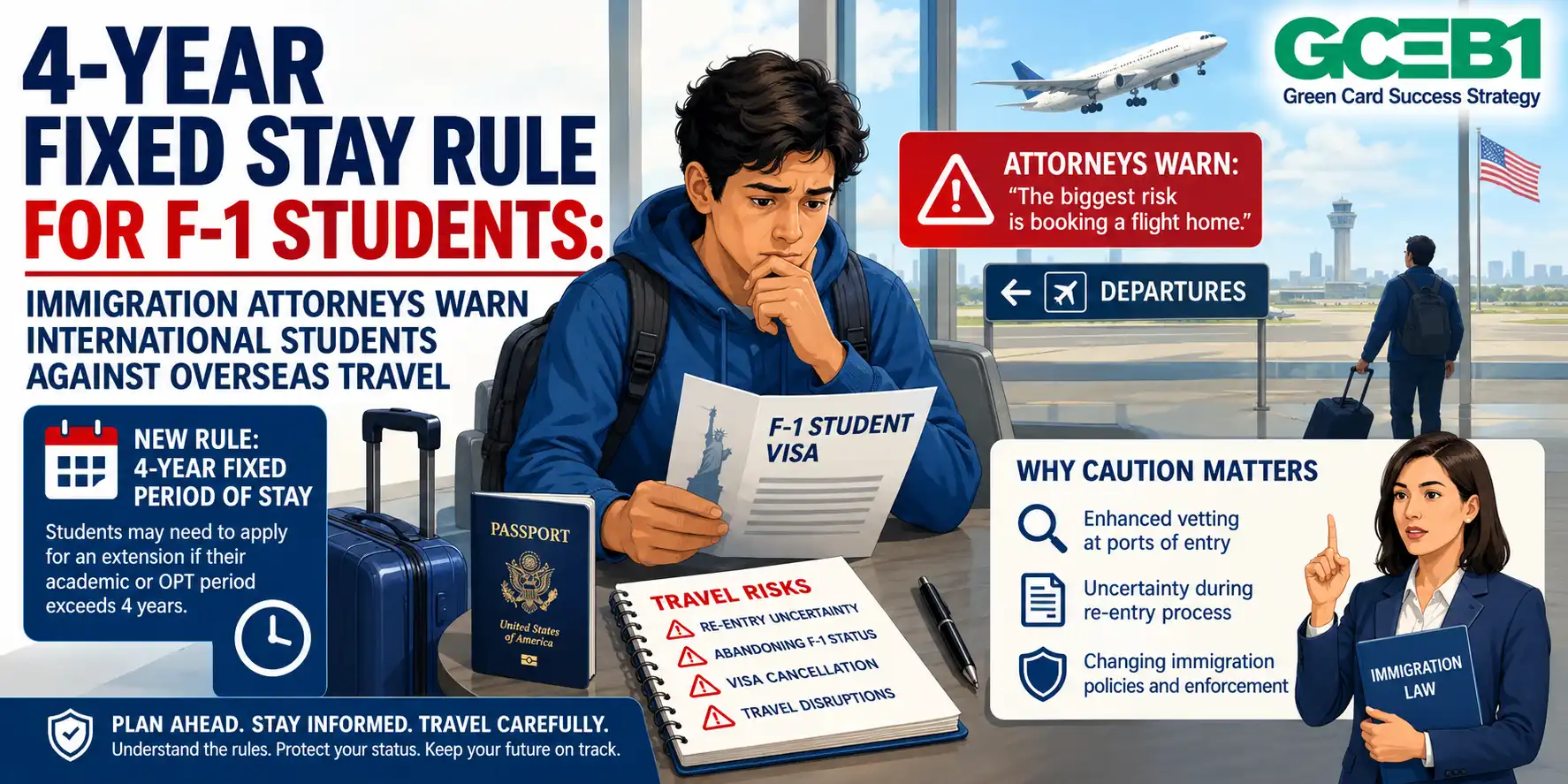
The Trump administration has finalized a rule that ends the decades-old "duration of status" policy for international students and replaces it with a fixed period of authorized stay. The rule is slated for publication on July 17 and takes effect around September 15, 2026. While the four-year cap has drawn most of the attention, immigration experts point to a quieter risk that many students have long taken for granted: leaving the United States while on an F-1 or J-1 visa.
The regulation sets a four-year fixed period of authorized stay for most F-1 students. Before, a student could stay in the country for as long as they kept valid status and met the requirements of their academic program, with no set end date. That flexible arrangement is now gone. The same fixed-stay approach also covers J-1 exchange visitors and holders of I visas, although international students are expected to be the group most heavily affected.
Under duration of status, often shortened to D/S, students were admitted without a predetermined expiration date. They simply had to stay enrolled full time and follow visa rules. The new framework instead grants an initial four-year window. Anyone whose studies or professional plans run longer, including those on Optional Practical Training or other qualifying activities, must ask the Department of Homeland Security (DHS) for an extension before the authorized period ends.
Although the four-year limit has sparked wide debate, attorneys say the travel consequences deserve just as much attention. Immigration attorney Emily Neumann told the Times of India that, for F-1 students currently in the country, the greatest risk is booking a flight home. She stressed that students who leave could face uncertainty when they try to return under the new system.
Neumann also offered some reassurance. Students who are already in the United States and maintaining status when the rule takes effect need not rush to file anything. In her words, they are generally protected until the earliest of three events: the end date on their I-20, the four-year mark (roughly September 15, 2030), or a status violation.
She further explained how travel works differently now. A trip abroad no longer simply renews an old D/S admission. After September 15, returning students will be readmitted with a fixed-date I-94, and the departure window shrinks from 60 days to 30.
Under the old system, a return trip meant walking back in with the same open-ended admission. Now every entry produces a new, dated I-94 record, which makes each border crossing a moment that shapes a student's remaining time in the country. A trip that once felt routine, such as visiting family during a break or attending a conference overseas, now carries added planning considerations. For that reason, attorneys advise students to weigh whether a journey is truly necessary, and, if it is, to consult a designated school official or immigration lawyer well before buying tickets.
Several dates now sit at the center of the F-1 experience. July 17 marks the scheduled publication of the rule, while September 15, 2026 is the approximate effective date. For students already in the country on that day, the outer boundary of protection is roughly September 15, 2030, unless an earlier I-20 program end date or a status violation intervenes. Travelers who re-enter after September 15 will see a specific date printed on their I-94 record, and the departure window has been cut in half, from 60 days to 30.
The rule is not limited to future applicants. Many people already studying in the United States will feel its effects, depending on their status and future plans. Students whose academic paths need more than four years, whether because of extended degree programs, research commitments, or time on OPT, will have to manage their immigration timelines actively and file extension requests before their authorized stay runs out.
The rule highlights how important long-term planning has become for international students. Under D/S, following visa regulations was generally enough to keep lawful status. The new framework adds a layer of administrative responsibility: students must keep track of expiration dates and request extensions when needed. Missing a deadline is no longer a technicality, since the fixed date now defines how long a student may lawfully remain.
Drawing on the attorneys' comments, students can keep a few points in mind. First, those already in the country and in good standing do not need to file anything immediately. Second, protection lasts until the earliest of the I-20 end date, the four-year mark, or a status violation. Third, international travel now triggers a new fixed-date I-94 with a shorter 30-day departure window. Finally, anyone expecting to study or work beyond four years should plan an extension request with DHS ahead of time.
The four-year limit matches the length of many undergraduate programs, but it may not suit every student's academic or professional path. Numerous programs, along with post-completion employment authorization, often stretch beyond four years. Put simply, following F-1 rules now means more than maintaining student status; it also means carefully managing the new fixed period of authorized stay.
Immigration rules are shifting quickly, and the details of how this rule is applied at ports of entry and through DHS extension procedures will matter as much as its text. Students, exchange visitors, and their families should follow official guidance, keep in contact with their school's international student office, and seek legal advice for complicated situations. Until the practical effects become clearer, the safest approach, according to the attorneys cited here, is simple: stay informed, plan ahead, and think carefully before leaving the country. We wish every student a safe and smooth immigration journey.




 Australia
 India
India Singapore
 United Kingdom
 Germany
 South Africa
 New Zealand
 Nigeria
 Canada
 France
 Spain
Spain Italy
Italy Ireland
 UAE
UAE