| Ad Type | I am offering |
Manufacturing is rapidly evolving with automation, connected machinery, and data-driven operations. As factories become smarter, traditional surveillance systems are no longer sufficient for managing worker safety, production efficiency, and operational compliance. Manufacturers now require systems that can analyze activities in real time, identify potential risks, and provide actionable insights instead of simply recording footage.
This is where AI video analytics for manufacturing plays a crucial role. By combining artificial intelligence with computer vision, manufacturers can continuously analyze live video streams, detect safety violations, monitor production processes, and improve operational visibility across the factory floor. From worker safety to quality assurance, AI-powered surveillance is becoming an essential component of modern smart factories.
AI video analytics for manufacturing uses artificial intelligence and computer vision to interpret live video captured by factory cameras. Instead of relying on manual monitoring, the system automatically detects predefined events, analyzes activities, and generates alerts when abnormal situations occur.
Unlike conventional CCTV systems that only record video, AI-powered analytics transforms surveillance footage into meaningful operational intelligence.
It can monitor:
Worker safety
Production lines
Equipment activity
Material movement
Restricted zones
Vehicle movement inside facilities
Quality inspection processes
Operational workflows
This enables manufacturers to respond faster while improving safety and productivity.
Modern factories generate vast amounts of operational data every day. Manual monitoring of hundreds of cameras is both inefficient and prone to human error.
AI-powered surveillance enables factories to:
Detect incidents automatically
Improve worker safety
Reduce manual supervision
Monitor multiple production areas simultaneously
Improve operational efficiency
Generate actionable insights
Support regulatory compliance
Reduce production downtime
One of the biggest advantages of real-time manufacturing surveillance is the ability to identify issues as they happen rather than after production has been affected.
AI continuously analyzes live video to detect:
Unauthorized entry
Unsafe worker behavior
Equipment anomalies
Blocked emergency exits
Restricted area violations
Production bottlenecks
Congestion on the factory floor
Unexpected operational events
Real-time visibility allows supervisors to respond quickly and minimize disruptions.
Worker safety is one of the highest priorities in every manufacturing facility. Manual inspections alone may not be enough to ensure consistent compliance with Personal Protective Equipment (PPE) requirements.
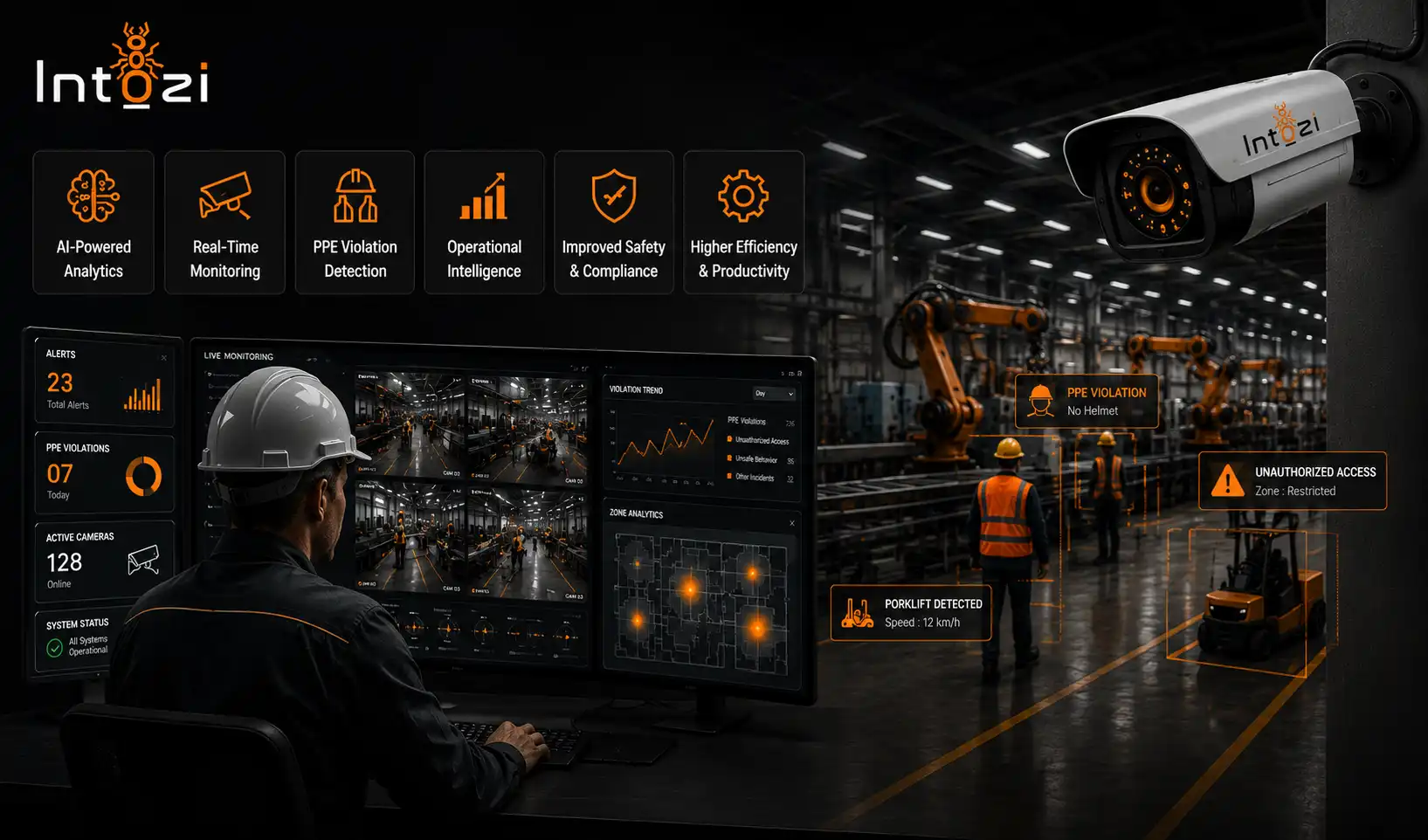
AI PPE violation detection manufacturing systems automatically identify workers who are not wearing mandatory safety equipment.
They can detect:
Missing safety helmets
Missing reflective jackets
Missing gloves
Missing safety goggles
Missing face shields
Improper PPE usage
Missing safety shoes
Missing harnesses in elevated work areas
When a violation is detected, supervisors can receive immediate alerts, allowing corrective action before an incident occurs.
Beyond safety, AI video analytics contributes to overall operational performance.
Manufacturers can use AI to:
Monitor production workflows
Track equipment utilization
Analyze worker movement
Identify idle time
Reduce operational delays
Improve production visibility
Support process optimization
Generate operational reports
These insights help factories improve efficiency while maintaining consistent production quality.
The adoption of Manufacturing Vision AI in India is increasing as manufacturers embrace automation and smart factory initiatives.
Indian manufacturing organizations are implementing vision AI to:
Improve worker safety
Strengthen compliance
Optimize production
Reduce manual inspections
Improve quality assurance
Support digital manufacturing initiatives
Enhance operational visibility
Increase productivity
As manufacturing expands across automotive, pharmaceuticals, electronics, food processing, textiles, and heavy industries, Vision AI is becoming an important technology for sustainable industrial growth.
AI-powered manufacturing surveillance supports a wide range of industries, including:
Automotive manufacturing
Electronics manufacturing
Pharmaceutical production
Food and beverage processing
Chemical manufacturing
Textile production
Steel and metal industries
Cement manufacturing
Packaging facilities
Heavy engineering
Each industry benefits from improved safety, operational visibility, and intelligent automation
Organizations can maximize the value of AI by following these best practices:
Deploy cameras in high-risk and high-value production areas.
Configure AI models for industry-specific use cases.
Define PPE compliance requirements for different work zones.
Set up real-time alerts for critical incidents.
Review analytics regularly to identify operational trends.
Train employees on AI-assisted safety procedures.
Continuously evaluate AI performance and optimize detection models.
How Intozi Supports Smart Manufacturing with Ikshana
Organizations implementing AI-driven manufacturing strategies often require a platform that combines safety monitoring, operational intelligence, and computer vision in one solution.
Ikshana, the AI video analytics platform developed by Intozi, helps manufacturers analyze live video streams using advanced computer vision and artificial intelligence. It supports AI video analytics for manufacturing, real-time manufacturing surveillance, and AI PPE violation detection manufacturing to improve workplace safety, monitor production environments, detect operational risks, and provide actionable insights. As Manufacturing Vision AI in India continues to grow, Ikshana enables organizations to strengthen safety, optimize operations, and support smarter factory management through intelligent video analytics.
Smart factories require more than traditional surveillance systems. They need technologies that can understand events, identify risks, and provide actionable insights in real time. AI video analytics for manufacturing enables organizations to improve worker safety, optimize production, strengthen compliance, and enhance operational efficiency through intelligent automation. With capabilities such as real-time manufacturing surveillance, AI PPE violation detection manufacturing, and the growing adoption of manufacturing vision AI in India, manufacturers are building safer and more productive facilities. Platforms like Ikshana by Intozi demonstrate how AI-powered video analytics can help manufacturers transform surveillance into a strategic tool for smarter industrial operations.
AI video analytics helps manufacturers improve workplace safety, monitor production activities, detect operational risks in real time, and enhance overall factory efficiency through intelligent video analysis.
It automatically detects PPE violations, restricted area access, unsafe worker behavior, fire, smoke, and other safety risks, allowing supervisors to respond quickly.
Yes. Most AI video analytics platforms can analyze video from existing IP cameras, helping manufacturers upgrade their surveillance without replacing their current infrastructure.
Real-time manufacturing surveillance uses AI to continuously analyze live camera feeds and immediately identify safety incidents, operational issues, and unusual activities.
AI identifies whether workers are wearing required safety equipment such as helmets, gloves, safety vests, goggles, and safety shoes, then sends alerts if a violation is detected.
"Manufacturing Vision AI in India" refers to the use of computer vision and artificial intelligence in factories to improve safety, automate inspections, monitor production, and support smart manufacturing initiatives.
Industries such as automotive, pharmaceuticals, electronics, food processing, textiles, steel, chemicals, and heavy engineering commonly use AI video analytics to improve safety and operational efficiency.
Manufacturers can begin by identifying key use cases such as safety monitoring, PPE compliance, quality inspection, or production analysis, and then deploy an AI-powered platform like Ikshana by Intozi that integrates with their existing camera infrastructure.

 Australia
 Singapore
 United Kingdom
 United States
 Germany
 South Africa
 New Zealand
 Nigeria
 Canada
 France
 Spain
Spain Italy
Italy Ireland
 UAE
UAE